
May 8, 2026
Personality profiles are genuinely useful. But they’re measuring the wrong thing if what you need to fix is communication.
Picture this scenario. A leadership team has completed a well-regarded psychometric assessment. Everyone knows their colour, their type, their dominant style. They’ve had the workshop. They understand each other’s preferences. And six months later, the same communication problems persist.
The senior leader who bulldozes conversations still bulldozes them. The one who goes quiet under pressure still goes quiet. The one who gives relentless advice when people need to feel heard still can’t stop advising.
This isn’t a failure of the psychometric. It did what it was designed to do. The problem is that personality and communication are not the same thing — and conflating them leads organisations to solve the wrong problem.
Knowing who someone is doesn’t tell you how they talk. And it’s how they talk that determines whether they lead, influence, and connect effectively.
What Personality Assessments Actually Measure
The most widely-used psychometric tools — Insights Discovery, Myers-Briggs, DISC, Hogan — are built on decades of rigorous research. They measure real and meaningful things. Personality preferences. Behavioural tendencies. Motivational drivers. Potential derailers under stress.
These are important domains for coaches, OD practitioners, and HR professionals. Understanding that a leader is introverted, detail-oriented, or strongly driven by achievement is genuinely useful context for a coaching conversation.
But here is what every one of these instruments is measuring: a relatively stable internal architecture. Who someone is. How they prefer to process, decide, and engage with the world.
None of them measure the moment-to-moment mechanics of how that person actually talks.
Deloitte Human Capital Trends research (referenced in multiple leadership summaries) found that 92% of C-suite executives believe communication is a critical leadership skill, yet only 18% of leadership development programmes prioritise it sufficiently.
The Confusion Between Style and Talk
The conflation runs deep, and it’s easy to understand why. Personality-based tools often use communication-adjacent language. A ‘Sunshine Yellow’ type is described as expressive and enthusiastic. A ‘Cool Blue’ is precise and analytical. A high-Dominance DiSC profile is direct and results-focused.
This language creates the impression that knowing someone’s type tells you something about how they communicate. To a degree, it does. But the degree is much smaller than most practitioners assume — and the gap is where communication problems live.
Consider two leaders with identical Insights Discovery profiles: both ‘Dominant Red’, decisive, direct, competitive. In a board presentation, one commands the room — clear, confident, drawing others in with well-timed questions. The other talks over everyone, deflects challenge, and leaves the meeting having failed to land a single key point.
Same personality profile. Completely different communication.
The personality tool identified what they have in common. It couldn’t see the communication pattern that makes one an effective presenter and the other not.
Two people with identical personality profiles can communicate entirely differently. Because personality type and communication behaviour are different domains.
What Communication Actually Consists Of
If personality is the ‘who’, communication is the ‘how’. And the ‘how’ has a specific, observable structure — one that can be mapped, measured, and developed.
VoicePrint describes communication in terms of nine distinct modes of talk called voices. Each voice is a functional unit of talk — not a style or a preference, but a specific type of contribution that serves a particular purpose in conversation.
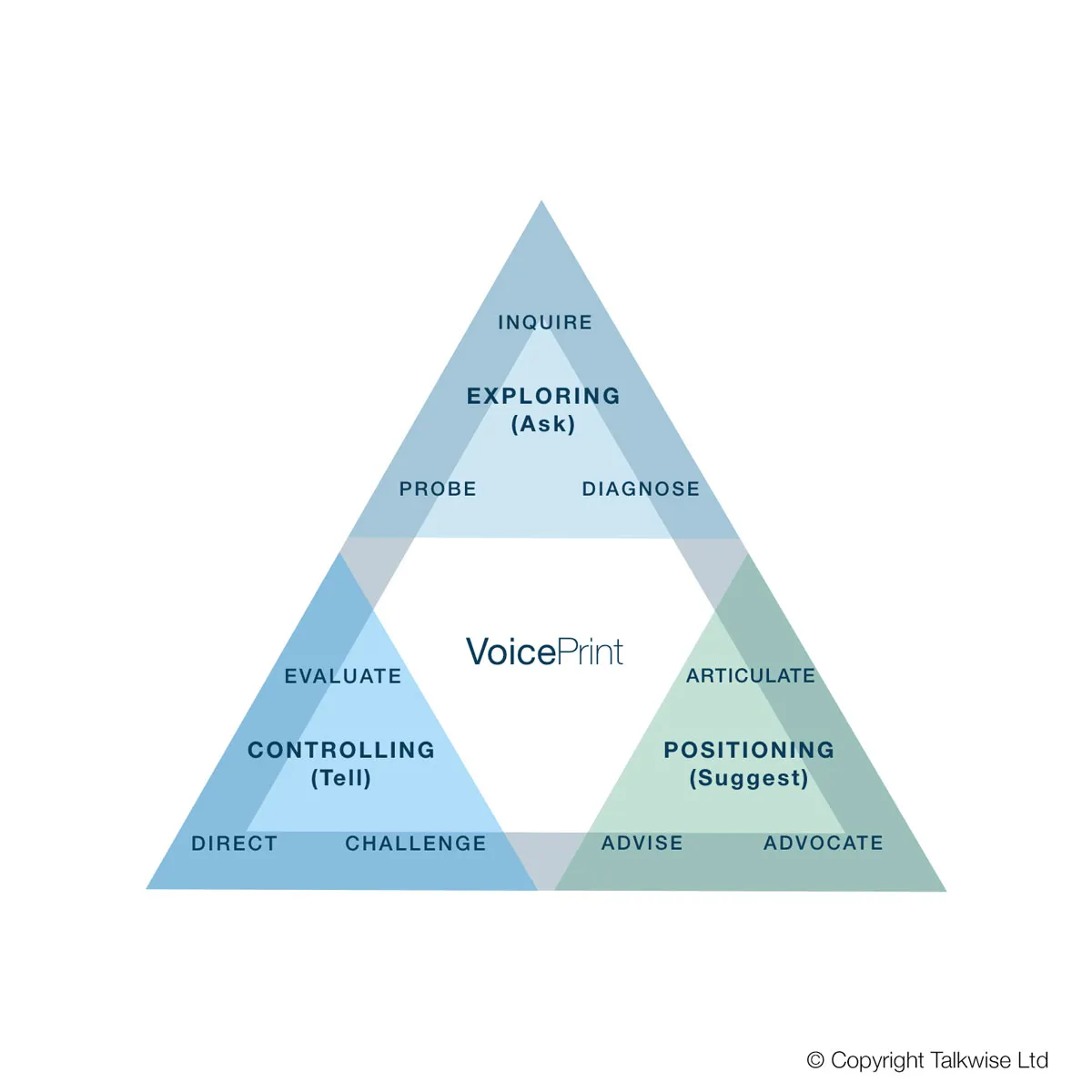
VoicePrint model Triangle with clusters of voices
Exploring voices — open dialogue and deepen understanding
- Inquire: genuine curiosity; creating space for others to think and contribute
- Probe: targeted questioning; extending understanding of a specific issue
- Diagnose: synthesis; identifying patterns and naming what’s really going on
Positioning voices — establish perspective and direction
- Advocate: stating a clear position or viewpoint
- Advise: offering guidance, suggestions, or recommendations based on your experience
- Articulate: summing up, clarifying priorities; naming what matters most
Controlling voices — set structure and drive accountability
- Direct: establishing direction and boundaries, holding people to account
- Challenge: disrupting patterns or assumptions to increase relevance
- Evaluate: weighing up, assessing quality and effectiveness
Think of it like a golf bag. Every voice is a club, each has a purpose. The best communicators have full range and they know which club to reach for on each shot. Most leaders, under coaching or not, are playing every hole with only three clubs.
Personality profiles don’t tell you which clubs are missing. They can’t — because they weren’t built to look inside the bag.
The Pressure Problem
There’s a further dimension that personality instruments address only partially — and it may be the most important one.
Most leaders communicate reasonably well under normal conditions. They’ve learned, over years, to manage their natural tendencies. The introvert has learned to speak up in meetings. The Dominant type has learned to listen, at least some of the time. The high Conscientiousness profile has learned to move on without having every detail.
But under pressure — in a difficult board conversation, a crisis, a performance review that’s going sideways — those learned behaviours fall away. People collapse back into their most dominant patterns. And it’s precisely in those high-stakes moments that communication tends to matter most.
Personality instruments describe stress behaviour in general terms. They might tell you that a high-Influence DiSC profile becomes more emotive under pressure, or that an MBTI Thinking type becomes more blunt. What they can’t show you is the specific communication pattern that emerges — which voices disappear, which ones become exaggerated, and what the person on the receiving end actually experiences.
Communication under pressure is where leadership effectiveness is really determined. It’s also the dimension that personality tools are least equipped to address.
VoicePrint’s pressure profile does something no personality instrument can: it maps how the individual’s voice pattern shifts specifically when they’re stretched. Often, the shift is dramatic. The leader who uses Inquire effectively in normal conversation loses it entirely under pressure, replacing it with a relentless Advocate. The manager who regularly challenges ideas goes silent when challenged themselves.
Seeing that pattern is the beginning of changing it.
Why This Matters for Practitioners
For coaches, HR consultants, and OD practitioners, the distinction between personality and communication has practical consequences.
If a client comes to you with a communication challenge — stakeholder influence, executive presence, team conflict, leadership impact — and you reach for a personality instrument, you’re diagnosing the situation with the wrong tool. The insight you generate will be real but incomplete. And the development work that follows will address the person’s style or preferences without touching the specific communication behaviour that’s actually causing the problem.
This is why so many leadership development programmes report that participants gain self-awareness but don’t actually change how they communicate. Awareness of your type is not the same as awareness of your talk.
“I’ve been on other management courses, but nothing has given me more insight into my own behaviour and its impact on other people than VoicePrint.” — Anne Harms, NHS Ward Manager
Communication-specific diagnostics don’t replace the value of personality tools. They address something different. In practice, many of the most effective coaching and OD practitioners use both — a personality instrument to understand the person’s underlying architecture, and a communication diagnostic to map what that architecture produces in actual conversation.
The combination is more powerful than either alone. But the communication diagnostic is the piece most practitioners are currently missing.
What Changes When You Measure Communication Directly
When you give a client a communication-specific diagnostic alongside their coaching work, several things shift.
First, the development becomes immediately actionable. Personality insights often require a translation step — ‘you’re a Cool Blue, so you might want to try being more expressive’. Communication insights don’t require translation. A client who can see that their Inquire voice drops to near-zero under pressure knows exactly what to practise.
Second, the change is observable. Because communication happens in the room, you and your client can notice in real time when a voice is absent or overused. The diagnostic gives you both the vocabulary to name what’s happening without making it personal.
Third, the results are measurable. VoicePrint clients show a 45% increase in their ability to communicate clearly and effectively to achieve desired results. That kind of outcome data is difficult to produce with personality-based development work — because personality, by design, is relatively stable. Communication behaviour is not.
The Takeaway
Personality assessments are valuable. They illuminate real differences between people and give coaching and development conversations a useful foundation. There is nothing wrong with using them.
But if communication is the presenting issue and in our experience, it almost always is, somewhere in the brief, a personality instrument will tell you about the person while leaving the communication problem untouched.
Understanding who someone is doesn’t tell you how they talk. And how they talk determines whether they lead effectively, influence stakeholders, build trust under pressure, and create the culture they intend.
Personality is the architect. Communication is the building.
If the building isn’t working, you need to look at the building not just the architect. VoicePrint works as a force multiplier when combined with other tools, unlocking their full value.
“As a leader, Andy moved from caution to confidence, from back foot to front foot, from inside his head to powerful externalised communication.”
— VoicePrint accredited practitioner
Ready for a conversation?
Get in touch